<?xml version="1.0" encoding="utf-8"?><feed xmlns="http://www.w3.org/2005/Atom" ><generator uri="https://jekyllrb.com/" version="4.3.4">Jekyll</generator><link href="https://chem-bla-ics.linkedchemistry.info/feed/by_tag/wiki.xml" rel="self" type="application/atom+xml" /><link href="https://chem-bla-ics.linkedchemistry.info/" rel="alternate" type="text/html" /><updated>2026-09-26T15:06:31+00:00</updated><id>https://chem-bla-ics.linkedchemistry.info/feed/by_tag/wiki.xml</id><title type="html">chem-bla-ics</title><subtitle>Chemblaics (pronounced chem-bla-ics) is the science that uses open science and computers to solve problems in chemistry, biochemistry and related fields.</subtitle><author><name>Egon Willighagen</name></author><entry><title type="html">Setting up a local Semantic MediaWiki with RDFIO and SPARQL support</title><link href="https://chem-bla-ics.linkedchemistry.info/2010/07/17/setting-up-local-semantic-wiki-with.html" rel="alternate" type="text/html" title="Setting up a local Semantic MediaWiki with RDFIO and SPARQL support" /><published>2010-07-17T00:00:00+00:00</published><updated>2010-07-17T00:00:00+00:00</updated><id>https://chem-bla-ics.linkedchemistry.info/2010/07/17/setting-up-local-semantic-wiki-with</id><content type="html" xml:base="https://chem-bla-ics.linkedchemistry.info/2010/07/17/setting-up-local-semantic-wiki-with.html"><![CDATA[<p>My now former student Samuel is doing a really cool <a href="http://en.wikipedia.org/wiki/Google_Summer_of_Code">Google Summer of Code</a>
project on import and export of <a href="http://chem-bla-ics.blogspot.com/search?q=RDF">RDF</a> from a
<a href="http://semantic-mediawiki.org/">Semantic MediaWiki</a> server. His <a href="http://saml.rilspace.org/screencast-rdf-import-and-sparql-update-in-semantic-mediawiki">screencast</a>
of today shows very nicely where things are going!</p>

<p>So, time to get something installed on my <a href="http://www.ubuntu.com/">Ubuntu</a> system, based on Samuel description here:</p>

<ol>
  <li><code class="language-plaintext highlighter-rouge">sudo aptitude install mediawiki-extensions php-apc imagemagick texlive-latex-base gs-gpl cjk-latex</code></li>
  <li>configure MediaWiki
    <ol>
      <li><code class="language-plaintext highlighter-rouge">zcat /usr/share/doc/mediawiki/README.Debian.gz | more</code></li>
      <li>follow instructions on <a href="http://www.mediawiki.org/wiki/Manual:Installing_Mediawiki_on_Ubuntu_10.04">http://www.mediawiki.org/wiki/Manual:Installing_Mediawiki_on_Ubuntu_10.04</a></li>
      <li>create a MySQL account as described <a href="http://techpad.co.uk/content.php?sid=89">here</a></li>
      <li>do config stuff at <a href="http://localhost/mediawiki/config/index.php">http://localhost/mediawiki/config/index.php</a></li>
    </ol>
  </li>
  <li>set up a save place for local checkouts for MediaWiki extensions
    <ol>
      <li><code class="language-plaintext highlighter-rouge">sudo mkdir -p /usr/local/lib/mediawiki/extensions</code></li>
      <li><code class="language-plaintext highlighter-rouge">sudo chown egonw:egonw -R /usr/local/lib/mediawiki</code></li>
    </ol>
  </li>
  <li>configure Semantic MediaWiki
    <ol>
      <li><code class="language-plaintext highlighter-rouge">cd /usr/local/lib/mediawiki/extensions</code></li>
      <li><code class="language-plaintext highlighter-rouge">svn checkout http://svn.wikimedia.org/svnroot/mediawiki/trunk/extensions/SemanticMediaWiki/</code></li>
      <li><code class="language-plaintext highlighter-rouge">cd /var/lib/mediawiki/extensions</code></li>
      <li><code class="language-plaintext highlighter-rouge">sudo ln -s /usr/local/lib/mediawiki/extensions/SemanticMediaWiki</code></li>
      <li><code class="language-plaintext highlighter-rouge">sudo nano /var/lib/mediawiki/LocalSettings.php</code>
        <ol>
          <li>add: <code class="language-plaintext highlighter-rouge">include_once("/var/lib/mediawiki/extensions/SemanticMediaWiki/SemanticMediaWiki.php");</code></li>
          <li>add: <code class="language-plaintext highlighter-rouge">enableSemantics('localhost');</code></li>
          <li>add: <code class="language-plaintext highlighter-rouge">$smwgShowFactbox= SMW_FACTBOX_NONEMPTY;</code></li>
        </ol>
      </li>
      <li>visit <a href="http://localhost/mediawiki/indSpecial:SMWAdminSpecial:SMWAdminex.php/Special:SMWAdmin">http://localhost/mediawiki/indSpecial:SMWAdminSpecial:SMWAdminex.php/Special:SMWAdmin</a></li>
    </ol>
  </li>
</ol>

<p>Next step is to install Samuel’s extension in its requirements:</p>

<ol>
  <li>set up the required extensions SMWWriter and POM:
    <ol>
      <li><code class="language-plaintext highlighter-rouge">cd /usr/local/lib/mediawiki/extensions</code></li>
      <li><code class="language-plaintext highlighter-rouge">svn checkout http://svn.wikimedia.org/svnroot/mediawiki/trunk/extensions/SMWWriter/</code></li>
      <li><code class="language-plaintext highlighter-rouge">svn checkout http://svn.wikimedia.org/svnroot/mediawiki/trunk/extensions/PageObjectModel/</code></li>
      <li><code class="language-plaintext highlighter-rouge">cd /var/lib/mediawiki/extensions</code></li>
      <li><code class="language-plaintext highlighter-rouge">sudo ln -s /usr/local/lib/mediawiki/extensions/SMWWriter</code></li>
      <li><code class="language-plaintext highlighter-rouge">sudo ln -s /usr/local/lib/mediawiki/extensions/PageObjectModel/</code></li>
    </ol>
  </li>
  <li>apply the patch (where is it filed upstream?)
    <ol>
      <li><code class="language-plaintext highlighter-rouge">cd SMWWriter</code></li>
      <li><code class="language-plaintext highlighter-rouge">wget http://saml.rilspace.com/smwwriter-fixesfor-rdfio-20100716-r2.patch</code></li>
      <li><code class="language-plaintext highlighter-rouge">patch -p0 &lt; smwwriter-fixesfor-rdfio-20100716-r2.patch</code></li>
    </ol>
  </li>
  <li>set up the RDFIO work from Samuel
    <ol>
      <li><code class="language-plaintext highlighter-rouge">cd /usr/local/lib/mediawiki/extensions</code></li>
      <li><code class="language-plaintext highlighter-rouge">mkdir RDFIO</code></li>
      <li><code class="language-plaintext highlighter-rouge">cd RDFIO</code></li>
      <li><code class="language-plaintext highlighter-rouge">svn checkout http://smwrdfio.googlecode.com/svn/trunk/ .</code></li>
      <li><code class="language-plaintext highlighter-rouge">sudo nano /var/lib/mediawiki/LocalSettings.php</code>
        <ol>
          <li>and add the RDFIO blob given on Samuel’s <a href="http://code.google.com/p/smwrdfio/wiki/InstallAll">Install page</a></li>
        </ol>
      </li>
    </ol>
  </li>
  <li>install ARC2
    <ol>
      <li><code class="language-plaintext highlighter-rouge">cd /usr/local/lib/mediawiki/extensions/SemanticMediaWiki/libs</code></li>
      <li><code class="language-plaintext highlighter-rouge">wget http://code.semsol.org/source/arc.tar.gz</code></li>
      <li><code class="language-plaintext highlighter-rouge">tar zxvf arc.tar.gz</code></li>
    </ol>
  </li>
  <li>install the RDFIO pages onto the main page for easy access, add:
    <ol>
      <li><code class="language-plaintext highlighter-rouge">[[Special:ARC2Admin|ARC2Admin]]</code></li>
      <li><code class="language-plaintext highlighter-rouge">[[Special:RDFImport|RDFImport]]</code></li>
      <li><code class="language-plaintext highlighter-rouge">[[Special:SPARQLEndpoint|SPARQLEndpoint]]</code></li>
    </ol>
  </li>
</ol>

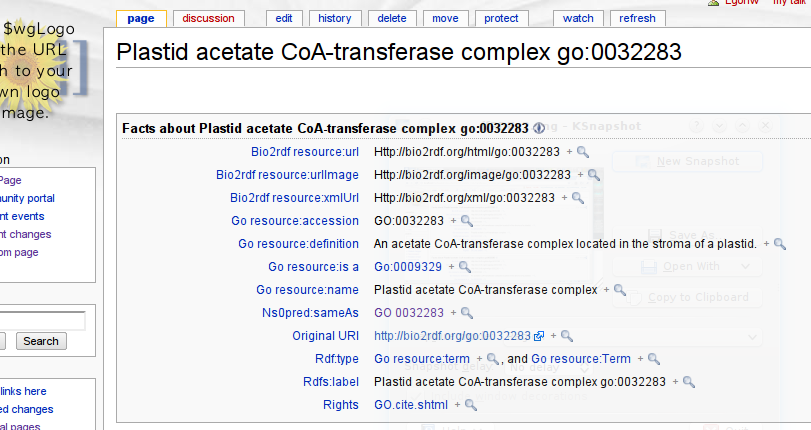
<p>That’s it. Not quite the 5 minutes that Samuel promised me, but I’m happy to have this available for my conference
tour next month! I installed the default RDF, and got the nice default wiki page to which I can now start adding
manual annotation:</p>

<p><img src="/assets/images/rdfImport.png" alt="" /></p>

<p>If you are wondering about the use case, this RDF import is ideal for building up knowledge bases, as detailed in my
<a href="http://chem-bla-ics.blogspot.com/2010/06/critical-mass-for-open-notebook-science.html">Critical mass for Open Notebook Science wikis by prepopulation with RDF data</a>
post last month. Just aggregate the info on the web you can find (yes, that’s another story), put it in your wiki
and complement it with your local knowledge, import into <a href="http://www.bioclipse.net/">Bioclipse</a>,
and run your analyses to verify your hypotheses!</p>

<p>Thanx to <a href="http://saml.rilspace.org/">Samuel</a> for this really great work!</p>]]></content><author><name>Egon Willighagen</name></author><category term="rdf" /><category term="sparql" /><category term="wiki" /><category term="bio2rdf" /><category term="bioclipse" /><summary type="html"><![CDATA[My now former student Samuel is doing a really cool Google Summer of Code project on import and export of RDF from a Semantic MediaWiki server. His screencast of today shows very nicely where things are going!]]></summary><media:thumbnail xmlns:media="http://search.yahoo.com/mrss/" url="https://chem-bla-ics.linkedchemistry.info/assets/images/rdfImport.png" /><media:content medium="image" url="https://chem-bla-ics.linkedchemistry.info/assets/images/rdfImport.png" xmlns:media="http://search.yahoo.com/mrss/" /></entry><entry><title type="html">Critical mass for Open Notebook Science wikis by prepopulation with RDF data</title><link href="https://chem-bla-ics.linkedchemistry.info/2010/06/26/critical-mass-for-open-notebook-science.html" rel="alternate" type="text/html" title="Critical mass for Open Notebook Science wikis by prepopulation with RDF data" /><published>2010-06-26T00:00:00+00:00</published><updated>2010-06-26T00:00:00+00:00</updated><id>https://chem-bla-ics.linkedchemistry.info/2010/06/26/critical-mass-for-open-notebook-science</id><content type="html" xml:base="https://chem-bla-ics.linkedchemistry.info/2010/06/26/critical-mass-for-open-notebook-science.html"><![CDATA[<p>One of the problems with Open Data, - Source, and Standards (<a href="http://chem-bla-ics.blogspot.com/2007/10/why-odosos-is-important.html">ODOSOS</a>) is
to get critical mass: for the project to move forward, you need both a good user community and an active developers community. The first is the
crucial reward for the latter: people using your work is the incentive. Sometimes, a project does not succeed in doing that; Rich was
<a href="http://depth-first.com/">questioning</a> if his <a href="http://chempedia.com/">ChemPedia</a> project <a href="http://depth-first.com/articles/2010/06/22/what-about-chempedia">built up enough mass</a>.</p>

<p>This also applies to wikis. <a href="http://wikipedia.org/">WikiPedia</a> clearly has enough critical mass, but is struggling with scaling, which is another
problem you can encounter. Building a dedicated, domain specific wiki allows you to do things the way you like. For example, the can be used to
build up the knowledge base around a specific problem. For example, HIV drugs (see <a href="http://hivdb.stanford.edu/">HIVdb</a> as an example knowledge base).
The wiki could contain information you need for your data analysis. The developers team will likely be small, but the data will be highly curated.
You are basically both the developer and the user community. Hopefully, in good <a href="http://en.wikipedia.org/wiki/Open_Notebook_Science">Open Notebook Science</a>
manner, things will grow, and others will join in on building the knowledge base.</p>

<p><a href="http://semantic-mediawiki.org/wiki/Semantic_MediaWiki">Semantic MediaWiki</a> bridges the human readable wiki content, with machine readable RDF
content. This wiki does require some additional annotation, but at the same time makes important facts machine readable. The
<a href="http://wiki.bioclipse.net/">Bioclipse Wiki</a> is using it, though we are not yet taking advantage of the RDF exposure.</p>

<p>Now, returning to the critical mass aspect we started with. Samuel, who did a project with me on reasoning with
<a href="http://saml.rilspace.org/content/3rd-project-update-integrating-swi-prolog-for-semantic-reasoning-in-bioclipse">Prolog in Bioclipse</a>, is now
doing a <a href="http://en.wikipedia.org/wiki/Google_Summer_of_Code">Google Summer of Code</a> <a href="http://saml.rilspace.org/tags/gsoc2010">project</a>
(is there any significance in the fact that three <a href="http://www.bioclipse.net/">Bioclipse</a> developers are student or have been mentor in the GSoC? :)
within the Semantic MediaWiki project. In particular, one of the things he was just working on, is the
<a href="http://saml.rilspace.org/populating-smw-from-rdfxml-first-test">import of RDF into a wiki</a>.</p>

<p>Oh goodies! That is pretty cool, don’t you think? Just pull together RDF from your field of interest, drop it on the wiki, and you have your
initial wiki the experts can continue to curate, add facts, etc. He already told me about his plans to add a
<a href="http://en.wikipedia.org/wiki/SPARQL">SPARQL</a> end point for the Semantic MediaWiki software.</p>]]></content><author><name>Egon Willighagen</name></author><category term="openscience" /><category term="opendata" /><category term="sparql" /><category term="wiki" /><category term="gsoc" /><summary type="html"><![CDATA[One of the problems with Open Data, - Source, and Standards (ODOSOS) is to get critical mass: for the project to move forward, you need both a good user community and an active developers community. The first is the crucial reward for the latter: people using your work is the incentive. Sometimes, a project does not succeed in doing that; Rich was questioning if his ChemPedia project built up enough mass.]]></summary></entry></feed>